About the Beinecke Legacy
“...to create and administer a distinguished scholarship program for young men and women of exceptional promise…”
In 1982, Frederick W. Beinecke, II (“Rick”), The Sperry Fund’s president, was handed the baton by his father, William (“Bill”) Sperry Beinecke, to steward the philanthropy’s resources and grow the Beinecke Scholarship Program.
A little over ten years earlier, in 1971, Bill Beinecke, chair and chief executive officer of The Sperry and Hutchinson Company (S&H), established the Edwin, Frederick, and Walter Beinecke Memorial Scholarship Program as a tribute to his father and two uncles. The goal of this program was to identify and support extraordinary American young scholars.
The roots of the Beinecke family’s passion for education go back to Edwin, Frederick (“Fritz”), and Walter Beinecke, born in New York City in 1886, 1887, and 1888. They were linked from their earliest years by their shared interests and deep affection for each other. The Beinecke Rare Book and Manuscript Library, given to Yale University by them in 1963, stands as a symbol of their bond.
Rick, named after Fritz, his grandfather, carries this legacy to this day.
Over the Decades

Thomas A. Sperry establishes The Sperry and Hutchinson Company (S&H), the nation’s first independent trading stamp business.

The Beinecke brothers (Edwin, Fritz, and Walter) become directors and take leadership roles that help guide S&H’s rise.
The Beinecke brothers name William Sperry Beinecke (“Bill”) as general counsel of S&H, and under Bill’s leadership, S&H quickly grows into a Fortune 500 company. Bill subsequently becomes vice president, and then president, and finally serves as chairman & CEO from 1966 until his retirement in 1980.
As a civic and corporate leader, Bill was an ardent advocate for nonprofits, especially educational projects. He set the pace for corporate charitable giving in the U.S. and supported greater opportunities for all. He promoted the advancement of women in corporate America.

Bill Beinecke proposes creating a distinguished scholarship program to honor his father and uncles and support exceptional young scholars.
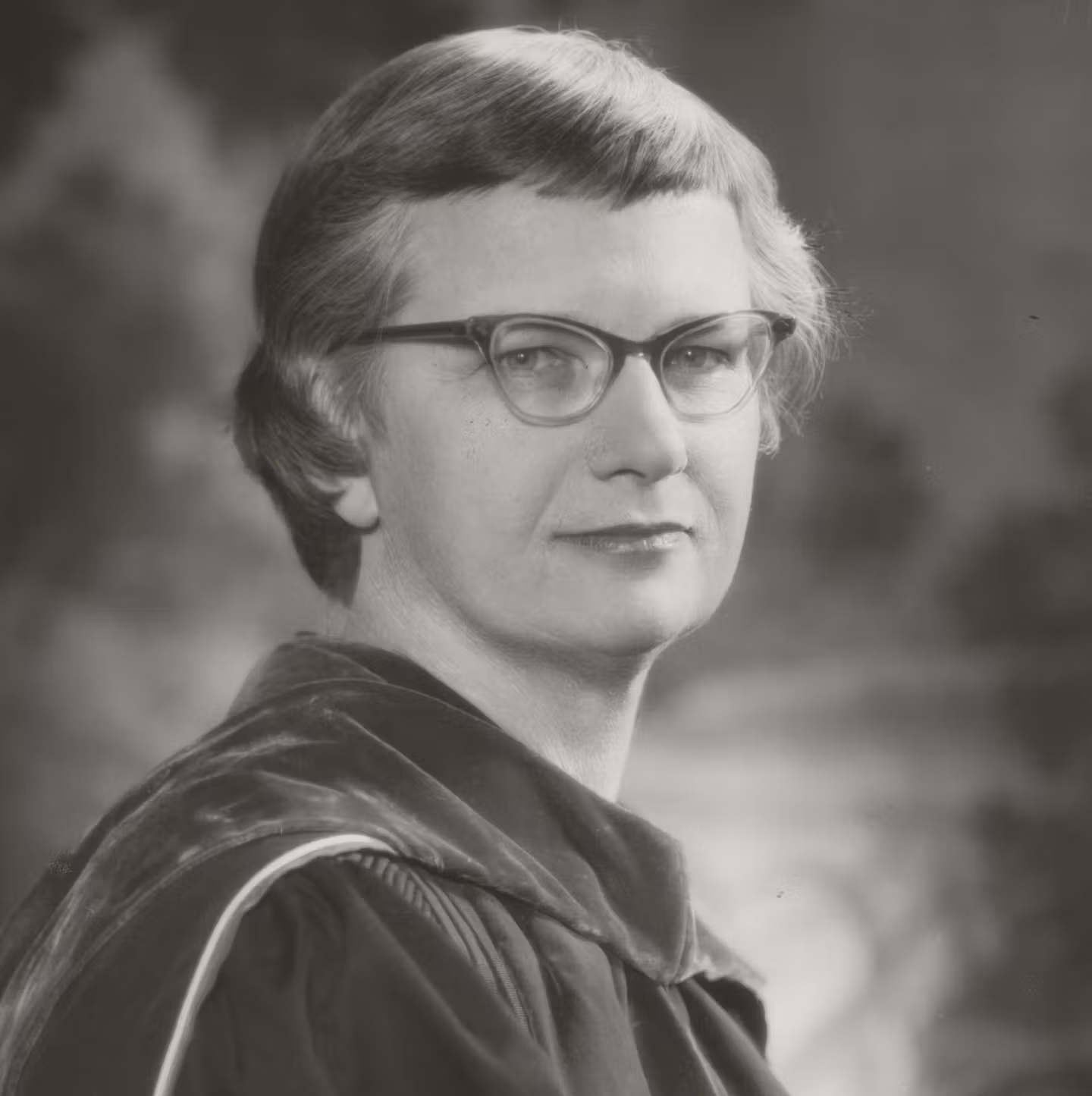
Paul Mott was the S&H Foundation’s executive director with the longest tenure. A leader in New York City philanthropy, Mott was also the executive director of The Prospect Hill Foundation in the 1970’s, and also led the Tomlinson Family Foundation. In 1985, he was appointed executive director of the Altman Foundation. In 2010, after Fred M. Kirby, II, passed away, Paul became the head of the F. M. Kirby Foundation, where he served for 22 years.
The first four scholarships for graduate study are awarded. The Beinecke Scholars are Jefferson Lievense (University of Michigan), Leah McCormack (Smith College), David Scott (Pomona College), and Charles Visser (Dartmouth College).
Harry S. Coleman becomes the second Program Director, continuing a deeply individualized style of scholar support for the next 15 years.
Following major corporate changes, including the sale of The S&H Company in 1981, the foundation becomes The Sperry Fund. As Bill approaches his retirement and considers his legacy, he envisions the Beinecke Scholarship Program as central to the Beinecke’s long-term identity of academic scholarship and educational opportunity. In order to realize this vision, Bill appoints his eldest son, Rick Beinecke to take the helm of The Sperry Fund.

Stewarding the vision and resources of The Sperry Fund, Rick seeks an appropriate partner to help lead The Sperry Fund. He nominates his law school peer and friend, R. Scott Greathead to the Fund’s board of directors. Scott had spent ten years in the New York State Attorney General’s office overseeing all bureaus, including charities and nonprofit organizations. A well-respected international human rights lawyer, Scott was a founding member of Human Rights First and Human Rights in China. Scott is elected secretary of The Sperry Fund and serves as a director and officer until his death in 2024. His expertise in tax-exempt law and charitable organizations, including philanthropy, is invaluable to the Fund.
“The program supports a diverse group of wonderful kids doing incredible things—some will be famous in the future, some are famous now.”
—Scott Greathead
Rick identifies Tom Parkinson, the parent of a 1990 Beinecke Scholar, to become the third Program Director and to take the Beinecke Scholarship Program to a new level. A university professor himself, Tom’s career in academia informs his many contributions to the program. As the third Program Director, Tom professionalizes operations and significantly grows the program.
During his 22-year tenure, Tom mentors hundreds of scholars and expands the network of participating schools, strengthening national reach and representation.
Under Rick’s direction and in partnership with the Wildlife Conservation Society (WCS), The Sperry Fund launches an international leadership program to support emerging African conservation leaders. Scholarships to pursue graduate degrees in the U.S. and the U.K. are coupled with opportunities to develop networks and leadership, with the strong expectation of returning home to lead. The Beinecke African Scholarship initially awards one scholarship per year, later expanding to two annually. This new offering is developed in celebration of WCS's 100th anniversary.
The program formally shifts focus to humanities, arts, and social sciences, recognizing the limited funding options in these fields compared to STEM.

Beinecke African Scholar Michel Masozera helps drive major conservation outcomes in Rwanda, including the creation of Nyungwe Forest National Park.

Matthew Loar is named a Beinecke Scholar, not yet realizing the award would later shape his career, community, and leadership path.
After mentoring 450+ scholars and building much of the modern program structure, Tom Parkinson steps down.
“From the beginning, I sensed that the family wanted the Beinecke Scholarship to be more personal than other awards, with the director serving as both mentor and advisor. In my words, I served as a kind of ‘agent’ who looked out for their best interests.”
—Tom Parkinson
After an extensive search process, The Sperry Fund names physicist Diane Flynn as the fourth Program Director. Diane further streamlines systems, expands nominations, improves data processes, and strengthens a sense of community among Beinecke Scholars through social platforms and digital outreach. Diane restructures the Selection Committee to include Beinecke Scholar alumni.
“Diane Flynn helped me understand that the work of the Selection Committee is more art than science. Some nominations are obvious, and in others, we see an inkling of something special—the possibility that, with the right guidance and mentorship, this student will ignite and do great things.”
—Matthew Loar
2006 Beinecke Scholar Matthew Loar becomes the fifth Program Director and brings the program back to its essential tradition: in-person campus visits, deep advising, and strong advocacy for scholars navigating graduate school funding.
Diane Flynn transitions in 2023 to the role of Board Member and in 2024 is elected Secretary of The Sperry Fund.
In the 50 years since the inception of the Beinecke Scholarship, more than 750 scholarships have been awarded, 120 undergraduate institutions have participated, and 50 African environmental leaders have earned higher education degrees.
“The program has been in place nearly 50 years, supporting students to pursue careers in the humanities who would not have the financial means to go on to graduate work, and we are committed to continuing that.”
—Rick Beinecke
25 years later, there is much success to report. Several Beinecke Scholars have gone on to serve as WCS country directors, including Richard Malonga of Congo and Simon Nampindo of Uganda. Michel Masozera, 2000 Beinecke African Scholar from Rwanda, won the 2004 National Geographic/Buffett Award for Leadership in Conservation and served as Rwanda country director before moving to a regional leadership position for WCS. Today, African Scholar alumni play a range of leadership roles at WCS and within national governments, national and international NGOs, national universities, and multilaterals like the World Bank.
The Sperry Fund acknowledges and extends its deepest gratitude to Bethany Wall, our trusted researcher and consultant, for conducting general research, interviewing past Beinecke Scholars, and compiling the historical information above.
Early 1960s — The S&H Foundation is created & Polly Bunting is named to the S&H Corporate Board
As a civic and corporate leader, Bill was an ardent advocate for nonprofits, especially educational projects. He set the pace for corporate charitable giving in the U.S. and supported greater opportunities for all. He promoted the advancement of women in corporate America.
Elaine Pitt was an S&H executive and champion of women’s leadership at the company. A trusted colleague of Bill’s, she became S&H board’s first female director. Knowing that Bill was interested in education, she introduced him to her friend, Mary (“Polly”) Ingraham Bunting, then president of Radcliffe College and a pioneering force in women’s education. It was a fortuitous introduction as Bill was then starting to think about education as a focus for his nascent corporate philanthropy at S&H. He recruited Polly to join the S&H board of directors, and as she helped shape the framework of a new scholarship program, Bill asked her to help lead his new corporate philanthropy.
After S&H goes public, the S&H Foundation is formed as a hub for philanthropic giving, with education and leadership support as early focus areas. The first S&H Foundation board included Bill Beinecke, his cousin Edwin Beinecke, Jr., and other corporate leaders. The first executive director was Jack Mishou, who worked closely with Bill Beinecke.
1975 — Polly Bunting serves as the founding Program Director of the Beinecke Scholarship Program & the First Scholarships are awarded
The first four scholarships for graduate study are awarded. The Beinecke Scholars are Jefferson Lievense (University of Michigan), Leah McCormack (Smith College), David Scott (Pomona College), and Charles Visser (Dartmouth College).
Polly Bunting, the Program Director for the Beinecke Scholarship Program’s first four years, was responsible for shaping the scholarship program’s defining “personal touch.” Polly began the practice of writing personal letters to the Beinecke Scholars and creating personal relationships with each student. From the beginning, the Program is intentionally hands-on, with a director serving as mentor, advisor, and advocate—often traveling to meet Scholars one-on-one.
Born in Brooklyn, Polly Bunting graduated from Vassar College in 1931 and earned her master’s and doctoral degrees from the University of Wisconsin-Madison in only three years, emerging as a serious microbiologist. Early in her career, she taught at Bennington, Goucher, and Wellesley, and when her husband was recruited to Yale, Polly became a microbiology professor at Yale. Following her husband’s untimely death in 1954, Polly, a single young mother of four children, became dean of Douglass College at Rutgers and, in 1960, was named president of Radcliffe. In 1964, she became the first woman to serve on the U.S. Atomic Energy Commission. She gained national attention for speaking out vociferously against the prevailing “climate of unexpectation” for girls that all too often squandered female intelligence and talent. Quoted in a 1961 Time magazine article, Polly said, “Adults ask little boys what they want to do when they grow up. They ask little girls where they got that pretty dress. We don’t care what women do with their education.”
Committed to upending this paradigm, Polly sought ways to expand educational opportunities for all, with a special emphasis on marginalized individuals, such as women and others for whom education was not viewed as a viable path.
1979 — A new era of leadership under Harry S. Coleman
Harry S. Coleman becomes the second Program Director, continuing a deeply individualized style of scholar support for the next 15 years.
Born in 1926 in Manhattan, Henry Coleman earned undergraduate and graduate degrees from the Columbia University School of Engineering. Hired in 1948 by Columbia to assist the dean of the college, Harry administered all financial aid programs at Columbia through 1972. In April 1968, Harry was barricaded in his office by members of the Students for a Democratic Society and the Student Afro-American Society. Newspapers at the time quoted students, including demonstrators, commenting on how much they liked him!
Four years later, he was shot by a disgruntled student who had been asked to withdraw due to poor grades. Unphased, Harry carried on, serving as dean of students until his retirement in 1979. A 2006 Columbia College obituary describes how Harry “admitted, counseled, nurtured and stayed in touch with many generations of Columbia students; he was a teacher of many generations of staff members in Admissions, Financial Aid and the Dean’s Office, shaping the lives and careers of so many.”
His unbridled enthusiasm for education and natural inclination to advocate for students served him well as the director of the Beinecke Scholarship Program.
1982 — The Sperry Fund is born & Rick Beinecke is named President
Following major corporate changes, including the sale of The S&H Company in 1981, the foundation became The Sperry Fund. As Bill approaches his retirement and considers his legacy, he envisions the Beinecke Scholarship Program as central to the Beinecke’s long-term identity as an institution of academic scholarship and educational opportunity. To realize this vision, Bill appoints his eldest son, Rick Beinecke, to take the helm of The Sperry Fund.
Rick begins a lifelong journey to create one of the nation’s finest and most prestigious scholarship programs. His legacy is marked by his steady hand, thoughtful foresight, and unique capacity to seize and realize programmatic opportunities. Time and time again, Rick’s talent for recognizing The Sperry Fund’s potential to have an impact in its philanthropy and in the Beinecke Scholarship Program proves to be a tremendous asset.
The Sperry Fund is reorganized, and many of the foundation’s original directors step down. A new board composed of Bill Beinecke, Edwin Beinecke Jr., and Rick Beinecke is formed. In 1982, Melvyn (Mel) Shaffir, longtime legal counsel to the S&H company and trusted advisor, joined the Sperry Fund’s board. Mel brings a strong understanding of the nonprofit sector and serves as an active board member until 2022, a year before passing away.
1994 — Tom Parkinson brings systems & scale
Rick identifies Tom Parkinson, the parent of a 1990 Beinecke Scholar, to become the third Program Director and to take the Beinecke Scholarship Program to a new level. A university professor himself, Tom’s career in academia informs his many contributions to the program. As the third Program Director, Tom professionalizes operations and significantly grows the program. During his 22-year tenure, Tom has mentored hundreds of scholars and expanded the network of participating schools, strengthening the national reach and representation.
During the 90s, Rick and Tom introduced a key policy change to the Beinecke Scholarship Program that improved its fairness: eligible schools can nominate one candidate each year.
“Tom brought a new level of assistance to the program. He was forceful with school administrators in confirming proper disbursement of funds and committed to ensuring that students connected with graduate schools that were a good fit.”
—Rick Beinecke
A Dartmouth College graduate, Tom Parkinson received his MBA and Ph.D. from the University of Massachusetts at Amherst. He spent his professional career in universities, teaching marketing at the University of Delaware, Penn State University, Lehigh University, and Moravian College (now University), among others. At Moravian, he became the first director of the MBA program, retiring as Professor Emeritus in 2003. He learned about the Beinecke Scholarship Program when his son Michael was named a 1990 Beinecke Scholar. Tom and Michael’s mutual friendship with then director Harry Coleman ultimately led Tom to become involved in the program. During his tenure, Tom developed the program structure and systems that are largely still in place; mentored over 450 graduate students; and traveled to over 100 colleges and universities in the United States, Canada, and Europe to meet with Beinecke scholars. Tom also helped Rick develop the Beinecke African Scholars Program in 1995.
1995-1996 — The Beinecke African Scholarship Program is launched
Under Rick’s direction and in partnership with the Wildlife Conservation Society (WCS), The Sperry Fund launches an international leadership program to support emerging African conservation leaders. Scholarships to pursue graduate degrees in the U.S. and the U.K. are coupled with opportunities to develop networks and leadership, with the strong expectation of returning home to lead. The Beinecke African Scholarship initially awards one scholarship per year, later expanding to two annually. This new offering is developed in celebration of WCS’s 100th anniversary.
“The African Scholarship program is targeted to support students already moving toward specific career paths, while the program for U.S. students broadens a student’s horizons to imagine something beyond their original assumptions. Both programs help students attain what may have previously seemed unattainable.”
—Frances Beinecke
As a trustee of the Wildlife Conservation Society since 1981, Rick served as co-chair of the International Conservation Committee and as a member of the Executive Committee. An advocate for global conservation issues, Rick traveled all over the world to visit WCS’s work. He understood the breadth and depth of WCS research and fieldwork, particularly on the African continent. In the early 1990’s, Rick already saw that young African conservation professionals faced multiple obstacles in accessing high quality doctorate programs. From his vantage point and experience with the Beinecke Scholarship Program in the U.S., Rick recognized that a scholarship program for Africans to attend graduate school in the United States could be advantageous on many levels.
An effective, well-respected organization working in tandem with conservation partners worldwide, WCS had long been committed to nurturing next-generation conservation leaders. WCS would be The Sperry Fund’s ideal partner. Rick tasked Tom Parkinson to work with senior WCS staffer John Robinson, the Joan L. Tweedy Chair in Conservation Strategy, to develop the new program. John was also a professor at the University of Florida, Gainesville, which hosts one of the most important research centers for tropical conservation in the world. This site would host many future African Beinecke scholars.
Beinecke Scholarship director Tom Parkinson and WCS staff, led by John Robinson, worked on the details of the new initiative. On the continent, the WCS network includes researchers with undergraduate degrees already working in junior positions in government agencies, local NGOs, and even within WCS itself. These early-career professionals are typically constrained by both financial capacity and limited local academic options in pursuing graduate study. The idea was that WCS would identify highly qualified candidates with potential for success, and that Tom would bring his persuasive power and relationships with university staff. Tom convinced universities that having international scholars in their graduate communities held value and effectively promoted foreign students’ unique qualifications and skills. For many African scholars fluent in French, Spanish, Portuguese, and German, English was not their first language. Nor had many lived abroad. Tom and his wife often met African students at the airport when they landed and made sure they had winter clothes. Throughout their stay in the U.S., the Parkinsons ensured the scholars felt at home. Today, Kate Mastro continues the role that Tom established and, in the spirit and practice of all Beinecke Scholarship directors, Kate and her WCS peers serve as advocates, advisors, and mentors for the African Scholars as they journey through their graduate studies in the U.S.
In the program’s early days, fewer college-educated African women were participating in the workforce; those who worked outside the home often had family obligations that precluded study abroad. Now that times have changed, the Beinecke African Scholarship Program applicant and scholar pool consistently shows greater gender parity.
After piloting this model, WCS approached other funders with its demonstrated success and leveraged additional grants to create similar international scholarships for other global regions. To date, the WCS Graduate Scholarship Program has awarded 152 scholarships across 41 countries. Of the 152 awardees, 46 are African. The Beinecke African Scholarship Program catalyzed greater access to education for dozens of other international scholars.
2017 — Diane Flynn brings modernization & wider visibility
After an extensive search process, The Sperry Fund names physicist Diane Flynn as the fourth Program Director. Diane further streamlines systems, expands nominations, improves data processes, and strengthens a sense of community among Beinecke Scholars through social platforms and digital outreach. Diane restructures the Selection Committee to include Beinecke Scholar alumni.
“Diane Flynn helped me understand that the work of the Selection Committee is more art than science. Some nominations are obvious, and in others, we see an inkling of something special—the possibility that, with the right guidance and mentorship, this student will ignite and do great things.”
—Matthew Loar
With an MBA from London Business School and a B.S. in Physics from Rensselaer Polytechnic Institute, Diane Flynn came to the scholarship world through the portal of space. A summer internship with NASA Langley’s Technology Transfer Program led to nearly 20 years studying and working in the U.K. as a strategy consultant and technology commercialization specialist in the public and not-for-profit sectors. An appointment by the British government as a Commissioner of the Marshall Aid Commemoration Commission led to her assignment as Chair of the New York region Selection Committee for the Marshall Scholarship program, a role she served for eight years. Her professional experience in change management, strategy, and operational development strongly informed her work in scholarship and academia. Viewing her leadership of the Beinecke program as a career highlight, Diane enthusiastically accepted an invitation to join The Sperry Fund board of directors in 2023.
